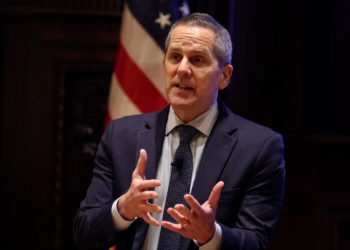


The deputy finance minister reveals that Russian citizens trade 50 billion rubles daily in cryptocurrencies.
According to news outlet RBC, the Russian finance ministry and central bank are pushing the government to accelerate the introduction of regulations for the crypto market, after it emerged that citizens spend nearly 50 billion Russian rubles ($648 million) in cryptocurrencies every day.
According to statements made by Russian Deputy Finance Minister Ivan Chebeskov during a digital asset discussion at the Alfa Talk conference, most crypto transactions occur through unregulated channels. “We have always said that millions of citizens are involved in this activity, we’re talking about trillions of rubles from the perspective of citizens in use, in savings,” Chebeskov explained.
The daily volume of 50 billion rubles cited by the deputy minister corresponds to an annual turnover of over 10 trillion rubles ($129.4 billion). “This is a turnover that is happening outside the regulated zone, outside our attention,” the government official emphasized, highlighting the need to bring this market under regulatory control.
The data demonstrates strong crypto adoption in the country, which is grappling with economic sanctions imposed by the United States and Europe. The European Union has recently raised concerns about Russia’s use of cryptocurrencies to circumvent sanctions and is pushing to “ban all crypto transactions with Russia” as part of a new sanctions package.
At the end of December, the Russian central bank released a policy proposal to allow both qualified and unqualified investors to purchase certain crypto assets. The proposal includes strict limits for unqualified investors, allowing them to hold up to 300,000 rubles ($3,834) of crypto annually, while permitting broad market access for qualified investors, excluding privacy coins.
Vladimir Chistyukhin, first deputy chairman of the Russian central bank, expressed hope to see crypto market regulation adopted by the government in the State Duma’s spring session. “We would very much like the government to see the law adopted in the spring session. I hope this is a possible consensus decision and this will provide an opportunity for a transition period for market participants to obtain the necessary licenses,” he stated.